Abstract:
It is widely known that Greece faces
one of the most precarious and transformative periods of its modern history.
Greek society has come to learn, in a baleful manner, that crisis is the
sequence of its former political inefficiencies and a slump that must be
overcome. The pressure of this awareness leads people to deface previously
established social convictions about the self and the world. In this procedure,
social and mass media articulate and (re)produce discourses from above, below
and the past so to capitalize the present for a new and solid horizon for the
future. This article challenges five beliefs that circulate in the Greek public sphere inculcating their
incontrovertible realities: the end of Post-Polity era (the ‘former’ political
status quo of Greece known as Metapolitefsi), the revival of ethno-socialist movements, the debt crisis of eurozone
countries, youth's stand for social change and the role Greece plays in this
global financial turmoil comprise the contents of this critical debate. What I
suggest, is that apart from the obvious misfortunes of crisis, the performative
effects of the imposed vision of the well-regulated state brings forth
collective feelings of offence and oppression in such ways that old divisive
ideas about Greece are awaken, reducing the country to a zone of social change
in which the subject renegotiates its sense of individuality and
community.
Introducing a precarious
state
The name Metapolitefsi
has come to identify the last 30 years of civic life in Greece. In Greek
it means the transition from one regime to another or from one way of being
involved in politics
to another. In the contemporary collective consciousness though, the name
embeds the fall of junta in 1974 and the institution of parliamentary
democracy. For British historian Mark Mazower (2000: 7), the name is connected
with Greece’s ‘return to some semblance of tranquility’ after ‘Europe’s
bloodiest conflict between 1945 and the breakup of Yugoslavia’ among the Left
and the Right that started even before the Second World War. The seven-year
junta, he observes, was the last bloody chapter of this civil conflict and, for
that, Metapolitefsi
embodies the promise of a new governmental state deprived of the terror of
ideological persecutions and national disunity.
The term Post-Polity
I use, aspires to capture the three-fold quality of the name Metapolitefsi that
itself obscures due to its historical weight: the political changeover of the
year 1974 (what is widely accepted in the Greek public sphere), the transition
of one regime to another (the etymology of the word itself) and the promise the
preposition post
(Meta) withholds, both as an effort to heal past wounds and a quest for a new
future. The Post-Polity regime that characterizes the last 30 years of Greece
is indeed so grounded to this promise, that it is unattainable to fully
understand the political transitions that happened within – such as Greece’s
dedication to the European vision and the ideal of the socio-democratic welfare state – or the
collective feeling of distress that have grown since 2009 due to the austerity
measures taken as to deal with the so called ‘debt crisis’, without taking
seriously the resurgent discourses about the ‘end of Metapolitefsi’ that
characterize today’s political rhetoric. In the present year of 2012, Greece is
under the International Monetary Fund’ s (IMF) instructions for structural
reforms inherent to the neo-liberal paradigm and, as a result, a new horizon is
procreated ‘from above’ with multiple side effects in the way people deal with their current predicament.
June’s 2012 election results evinced the five-year Greek
depression’s simmering trends; yet they still came with a shock for the public
sphere. They were a shock, above all, because of the destined way the results
affirmed themselves: the striking fall of the once dominant socialist party,
the change of the two-party
system after the youth, the ‘indignants’ and many other frustrated
people’s turn to the radical left, and the rise of the ethno-socialist
movements are some of the tangible events registered in the Greek social body.
At that time, voters and candidates, dazzled in front of the T.V. screens,
ruminated over the ‘already’ predicted yet seemingly unforeseen outcome. Fated
and expected as they were though, the Greek election results still mask the presence
of all these rampant and perilous events that color the current socio-political setting:
anti-immigrants attacks by armed para-state nationalist groups, forest arsons
on the eve of the election and stock market sabotages with en masse capital
flight affirm and expose the frightful financial and political web. This
unnerving scene cannot be seen as a consequence of Greek crisis alone, but as a
constitutive feature of this transitory period. Still, ‘Greek crisis’ can be a
flexible field for apprehending and communicating the symptoms of this
contemporary social change.
I. The post that never comes: ‘I’m
living a dream, don’t wake me up!’
Since the arrival of the IMF and the official
announcement of crisis, debates about the end of Post-Polity era has dominated
the political discourses. At the same time, the ‘post’ of the Post-Polity
regime was speculatively linked to the causes of the current misfortune and the
IMF’s proposed reforms. In brief, the ‘end of Metapolitefsi’,
has marked today’s collective imaginary, in reference to crisis only – a
condition I would like to discuss as a starting point for my reflections. The
German literary critic Andreas Huyssen discusses the ‘end of modernism’ in a
similar manner. He sees postmodernism
as a field of collective memory for the imaginative production of modernism.
‘The problem’, as he says, ‘is not what modernism really was, but rather […] how it
functioned ideologically and culturally after World War II’ (Huyssen 1986:
186). In a way, the post
for Huyssen has been introduced in the context of a disengaging process and has
served for the production of knowledge(s) displaced from the modern myths of
progress and rationality. In a similar fashion, I believe that the post of the
Post-Polity era exists only as a performative gesture of retrospective
accusation that functions as a political tool for the discomfiture of the
Post-Polity societal claims for a socio-democratic welfare state, and for the
acceptance of the sacrifices needed to reform the Greek society – in the
neo-liberal paradigm – for its return to much awaited political and financial
stability.
Thereby, the identity of that post media
usually portray to make the need of a new structural paradigm more plausible
and appealing doesn’t indicate an already
here present. It rather belongs to a manifold process of incriminating Greece’s recent
political past, aimed to support the abrupt importation of neo-liberal reforms
formerly considered ‘extreme’; disclosing, at the same time, the empowerment
and encouragement, in a local level, of ‘the same global rhetoric about
horizons of long-term economic growth’ (Guyer 2007: 410). Thus, this
incrimination process serves for the penalization of the epistemic and
ideological platform of the Post-Polity regime, leading all previous
governments to a rampant criticism in terms of corruption, misappropriation and
embezzlement. In result, the identity of that post
as an outcome of this incrimination performance synthesizes and channels a
public demand for a complete political change; a demand though, in which the
ideological platform of these streamlined accusations is delicately
masked.
To understand the identity of the post of the Post-Polity era in
accordance to the sensitive issue of the societal claim for change, we have to
ruminate over the imaginative construction of the past by the media and their
capacity to effectively channel public’s discomfort and complaints. It is imperative in order to
understand the massive salary and pension reductions – in some cases exceeding
the 50 per cent – the increase of working hours, the extensive dismissals of
bureaucratic personnel, the increase of personal taxes and the discontinuing of
many social provisions; measures impossible for a previous government to take,
and now enacted in only three years time. Because, for a society to accept the
dismissal of all its social accomplishments, means to feel critical for the
whole infrastructure that made them possible in the first place. So,
Greece performs this ‘new’ identity of the post, by preserving a collective
trauma (i.e. corruption, as the bankruptcy of Post-Polity’s promises) so to
recast the image of its past and to extort a different
– yet once criticized – field of innovations. Thus, the post of the Post-Polity
is not a temporal
event but an affective condition grounded in the population’s unconfessed complicity for the failures of Greece’s former
political and economical life. A complicity (re)produced dialogically with the
praise of a lawful and congruous state in the liberal market context.
II. The return of the damned
as (mass-mediated) democracy’s self-punishment
The imaginative construction of the Post-Polity era was
heralded in with the establish-ment of the democratic constitution. At the time
of the 1980s, the opening of the press and television market to private
interests, attached Post-Polity governments to the tele-visual way of
conversing with people and to mass media holders’ political and financial
interests. In the affective condition of the post,
this notion of ‘financial interests’ pertains to a grid of secret, masked and
undercover agreements that is not only used for the incrimination of Greece’s
most recent political past, but also for the mystification of the current
situation in terms of conspiracies and concealed – global or otherwise – plans.
Consequently, one of the manifestations of the political strategy to implicate
Post-Polity in the ordeals of the present is a sound distrust towards political
life as a whole, in addition to the general disregard of the (social)democratic
welfare.
In the Greek public sphere’s collective
imaginary, democracy’s corruption is felt, first and foremost, in the collapse
of expectations that were cultivated by the two main Post-Polity parties.
Previous election slogans remain engraved on voters’ memory, such as ‘The
citizen first’, ‘Greece first’, ‘Hat-in-hand’ and ‘People won’t
forget what the Right stands for’,
they are now internalised in the affective condition of the post and are
inverted from their initial meaning producing a nervous turn towards
nationalistic and patriotic movements; particularly towards the one that vaunts
for authenticity: Golden Dawn. The slogan ‘The citizen first’,
as the last ‘lie’ of the Post-Polity era becomes, in a reflective way, the ground
for questing that promise’s literal sense through the shadows and the ghosts of
the now wounded democratic system. In other words, mass-mediated democracy’s
promises are quested through the constitutive Other of Post-Polity’s regime,
which is the ‘reprehensible’ ethno-socialist ideal.
This turn to patriotic movements is,
obviously, coherent with the ultra right-wind streams of fanaticism that
dominated Greece in the years after the civil war (see Mazower 2000). The
Post-Polity regime had denoted, in a reserved way, the termination of the
ideological divisions through Greece’s devotion to the European
social-democratic ideal. And despite its incrimination, most people are not
willing to ‘remind’ themselves the post civil-war traumas. Since Golden Dawn’s
allocutions are disjoint from previous military languages, the ‘politics of
memory’ which permeate the political disputes of Post-Polity create a political
space in line with the affective condition of the post. Namely, Golden Dawn’s
rhetoric of hate on leftists, corrupted politicians, gays, foreigners, artists
and academics, is based on an accusation of national betrayal due to financial,
diplomatic or other partialities. This is the common
ground that relates the incrimination of the Post-Polity regime with the
fanatic ruffle of Golden Dawn: the affective condition of guilt being embedded
in the madness of revenge.
Thereby, Golden Dawn, the political
party/movement that, as mass media portray, cannot be controlled by ‘democracy’
shines through the darkness it promises and its unlawful attacks against the
corrupted political system. In voters’ consciousness, Golden Dawn becomes the
par excellence agent of blackmail that places the ‘citizen-punisher’ into
parliament life. It also becomes the carrier of the reformed model of
‘citizen’, a one that needs protection from the mass media, which are presented
by Golden Dawn as an instrument of the threatening global forces that lead
people to precarious states with their conspiratorial policies of nation, race
and gender boundary disturbance. The paradoxical relationship of hate between
Greek mass media and the Golden Dawn party reveals the power and the limits of
modern mass mediated democratic system, in which the claim for the ‘lost’
democratic ideal brings forth inglorious movements for democracy’s complete and
apocalyptic disablement.
III.
Greece in a ‘state of emergency’ or the state of exception as a condition of
crisis
It was after the elections of 2009 that Greece entered into economic
‘crisis.’ Its public announcement came from the lips of the newly elected prime
minister himself, G. A. Papandreou, who declared that Greece now was in a
‘state of emergency.’ On his invitation, consultants from the European Union
(EU) and the IMF arrived in Athens in no time to help the government take the
necessary steps to decrease the deficit and improve the economy overall. This
governmental discourse on Greece’s ‘state of emergency’ - as Greece’s state of exception
from the markets - was necessary for today’s crisis to take shape and for the
stigmatization of the Post-Polity regime as responsible for it. Additionally,
the vision of a lawful, modern and Europeanized state became the rule for this
‘state of exception’ to take shape, presaging and arranging a field of changes
and reforms which without crisis wouldn’t have been possible; and to which not
only Greece but all European countries must conform. Mass media and political
agents were the main channel for this grand narrative to take form and until
now the vision of a modernized state is still the one that acts as a metaphor
for a desired outcome.
The Italian philosopher Giorgio Agamben
uses Carl Schmitt’s concept of ‘state of exception’ to investigate the
exceptional measures taken in periods of political crisis. He believes that the
legal measures taken in states of exception cannot be easily understood from a
legal point of view. For him, they are political, insomuch as the state of
exception entails the paradoxical position of presenting itself as the legal form
of that which can have no legal form. He, then, stresses the importance of the
condition in which the state of exception becomes the rule, so the exceptional
measures turn into government techniques and, as a result, the once familiar
form of political constitution loses its traditional distinctions (Agamben
1998: 122). In a way, since this evasive state becomes the rule, an opening for
a space devoid of law occurs where different power relations may become
proximate As he puts it, the state of exception is the provenance of every
juridical placement since it opens up a space for the stabilization of a new
kind of order (Agamben 1998: 19).
Using Agamben’ s analyses, we may say
that the Greek government’s decision to except Greece from the markets, due to
its inability to fulfill its debt obligations, and put it under IMF’ s
patronage, as the figurative schema which supervises and controls them, is not
just part of a procedure that disciplines or re-programs Greece (what both ill
or well disposed discourses tend to put forward) but rather a part of one, that
tests the ability of the EU to sanction the new principles of its
restructuring. A speculation that leads us to think that the abrupt reforms
Greece is forced to adopt belong to a political intention of reforming European
governance. So, in a way, Greece, the last geographical and financial frontier
of the EU becomes, simultaneously, the barometer of European deficiencies and
the laboratory of multiple strategies for EU reform. In this sense, the ‘advanced
European country’ as the rule for the ‘state of exception’ to take shape
becomes the exception
itself, for Greece becomes now the lawless space in which the ‘new European
country’ is procreated. The fact that G. A. Papandreou declared with such ease
‘either we change or we sink’ to every European council denotes that there is a
vision of a new financial, governmental and state order at stake, which is
continuously being exceeded as a trace, although never denominated as such.
Thus, we may assume that the danger of
Euro’s collapsing doesn’t just show the ‘structural’ problems of the European
countries, but, much more, it shows the liberating ‘structural’ solution of a
more coordinated, flexible and effective governing mechanism. The language
Europeans officials use, such as the statements German and French prime
ministers frequently make about a ‘European government’, a ‘trans-European
executive authority’ or a constitution of a federation like the United States
of America (USA) don’t belong to an abstract vision of European consummation,
but they hold a very specific projection of a modernized European future, which
is being anticipated in the present as a virtual horizon through this crisis.
In this fashion, the ‘event of crisis’ is not just an objective social and
economic matter needing attendance, but a bio-political laboratory of key
signifiers that connect everyday life with the projection of the future.
IV.
Youth’s stand for change: ‘In these elections, we hide our grandparent’s ID
cards!’
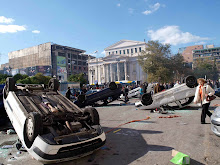
Greek society is filled with outbursts
of riots each and every time a package of austerity measures passes the
parliament. Images of the most raging scenes are traveling around the world
declaring, in a way, that the Greek public denies to submit to a change imposed
‘from above’. We might say that this disobedience belongs, in some measure, to
the same spirit of demanding political change, as the one that Theodore Roszak
(1968) finds in the ‘counterculture movement’ which flourished in the USA and
Western Europe in the 1960s. In his effort to make sense of the huge wave of
confidence people had in changing the world, Roszak observes that 50 per cent
of those populations was below the age of 25. In respect to his observation, I
ought to note, that Greece of 2012 has 50 per cent of its population over the
age of 40;
and it is this part that accomplished its life-goals at the Post-Polity era.
That means that a great deal of the Greek population operates with an outward
mark of obeisance towards the austerity policies, in fear of losing its vested
interests; while simultaneously, the young productive force embodies this part
of society that craves for change, as it suffers the unbearable violence of
austerity.
This picture becomes a lot evident during
the months running up to the June 2012 election. that were marked with massive
protests, riots and acts of disobedience. The confirmation of the belief for
‘discipline’ found Greeks tacitly divided, facing, through this ‘involuntary’
choice of austerity, memories of this ‘long forgotten’ polarization between the
Left and the Right. Through the 30 years of Post-Polity, these oppositions may
had been smoothed over, but, as Danforth and Boeschoten (2012) have shown,
there are still strong communities of memory – people that have witnessed the
civil war – that ‘would vote’ for stability only to ‘forget’ the past. That is,
this belief for discipline fully embodies the memory of past national
misadventures, while the youth, in an ironic way, incarnate the part of the
population that crave for change; even in the cost of dismantling the relative
peace made in the Post-Polity era. Thus, being young
in modern Greece means to feel a minority force in the construction of Greece’s
future. For a young person, to live in Greece means to partake in the
collective depression of seeing his/ her expectations and demands be set aside
for the sake of older people’s (bank accounts) safety and their fear of new
national misadventures. Hence, current prime minister Antonis Samaras’
rhetorical campaign dwelled on the catastrophic scenario of Greece’s exit of
eurozone is not such a surprise; as timid and divisive (and alien to the youths)
as it was, it intended to reach the terrified ears of the seniors. It was also
of no coincidence that in his first post-election speech he was eager to thank
‘the masses of youth that supported him’.
Half of Greece’s population has
experienced the post-war, post-occupation and/or post civil-war traumas. It
grew up out of ‘nothing’, yet with plenty of opportunities to make its dreams
possible. It also grew up
with the need to escape rural life and the desire to live the modern urban,
consumerist (and with one or two kids) nuclear family life. Greek families, as
shown in respective ethnographies, are formed with the principle of ‘honor’.
That is, the collectivity of the family is bounded when the individual’s shares
and interests conjoint with the safekeeping of the family’s private sphere.
Many theorists (Campbell 1983, Herzfeld 1987) have pointed ‘honor’ as an indicator
for both structural continuity and social change. Despite differences, all
commentators will agree that massive urbanization and industrial modernisation
have shifted the ways ‘honor’ is manifested, yet it is still a way to
understand the boundaries of the family by means of individual action. Yet, in
the site of crisis, this ‘peculiar Greek individualism’ (Abdela 2002: 218) is
presented in ambivalent terms. Because the boundaries of the family seem to
frame both of these contradictory tendencies of muffled safety and rabid
escapism; denoting the multiple articulation of ‘honor’ itself which family’s
private sphere retains.
On one hand, the image of the
paternalistic Greek family gets blurred in the misty shadow of crisis and
reveals an opportunistic dimension which face such a concern for its
offspring’s future, that it even accepts their sacrifice. On the other, the
idea we have of the overprotective behavior of the Greek family shatters with
the ‘event of crisis’, as ‘honor’ is detached from the strict connotations of
the family’s private sphere’s interests. Through these multiple shiftings in
individual concerns, the ‘young’ are forced to claim a space of ‘adult’
decisions and deny a juvenile precariousness, nourished by their elders. For
the adults, a sense of sacrificing the most sacred gifts like security and
(paternalistic) protection is produced, with their offspring as the first
victims, who now ought to re-learn how to be modern. Thus, current youth’s
stand for social change is not just clashing with some restraining and
conservative forces (what can be easily conceived through the mainstream
ideological platforms) but with an attitude of passive impartiality that shares
this uncofessed complicity for the ‘failures’ of the past. Crisis, as it seems,
is another plateau of modernization where the Greek subject reconfigures its
individuality and sense of community. It is a contemporary rite of passage for
Greek society; a process of violent adultness for all generations.
V.
Greece, the cradle of the world.
In an article of his that was popular within the Greek
public, British historian Mark Mazower (2011) says that Greece’s national
history goes hand in hand and sometimes presages the great changes of the
modern western world. The 19th century great empires’ fall, the
adventure and collapse of Nazism, the European cold war division, the expansion
of the EU and now the crisis of the worldwide financial system spark are, as he
points out, resultants of modern Greek history. At the same time, the little country
of Greece acquires the heroic and tragic role of being ‘in the forefront of the fight for the future.’
I don’t find the real role of Greece in the worldwide theatre of changes that
important; to my mind, each country partakes with a different role and degree
of tragedy in this play. But, what I really find interesting is that Mazower
takes up a philhellenic tradition in a time of war; representing Greece’s
various resistances ‘as the noblest of causes’.
In a
non-committal way, this popular article belongs to a storehouse of help that
encourages the revival of the Greek spirit, by internalizing in the collective
imagination the belief of a ‘Great Greece’ that holds the capacity of an
explosive way of participating in ‘worldwide negotiations’. Having the feeling
of this capacity means to cultivate, in a collective manner, the conviction
that not only Greeks are capable of, but it is incumbent upon them to
counteract against any assault to their private/national domain. The ability to
unilaterally terminate the memorandum and to refuse paying off the debt,
as well as the ‘invitation’ of an ultra-right wing ethno-socialist party in a
European parliament, belong to the same reactionary context fed by a tank of
allegories that share a common psychic denial best understood with the
psycho-analytical themes of sublimity, egocentricity, narcissism, fear of loss,
inability to accept criticism and various vindication fantasies.
What I actually want to say here is
that the existential fear of a country in crisis, once it internalizes the
capacity of assaulting the worldwide financial web, makes it ‘dangerous’
insofar as this country reflexively increases its metonymic power to protect
itself by means of attacking the joints of the skeletal structure which finds itself
entrapped in. So, to visualize the characteristics of a country in a precarious
state, one has to bear in mind this shrewd oscillation between the capability
of an explosive reaction and attending the exhortations for legitimacy. In that
sense – and in a diametrical opposition to Mazower’s view – for a country to be
‘the cradle of the world’ means to be a screen for projecting the worldwide
circulating needs for change and, at the same time, a camera that projects for
itself the eventualities of crisis as a virtual horizon for the whole world.
Greece as the cradle of the world is the crisis’ point of no return. And it
resounds the crisis’s center since it has been reduced to a laboratory of
multiple and contradictory narratives and metaphors of an imminent future
through the most common conspiratorial stories of the hidden, yet terribly
tangible, global financial relations.
‘Capitalizing’
these five thoughts
In illustration of what I have said, I am tempted to use another ‘common’
belief, one that is not only ‘Greek’ but, on the contrary, it resounds the
global image of the modern and well-regulated state in the market’s context. It
is the one saying that societies ought to control, as a moral stance, the
financial steering wheel of their country. In the event of crisis, we can see
that what this stereotype conceals is the disconnection of the steering wheel
from the rest of the vehicle’s navigation system and its participation in
automated, by ‘invincible’ programmers, steering movement transmission systems.
In the context of Greek crisis, it is a matter of trust of a faded and frayed
map, with a very great obligation involved in society’s part, to show a brave,
authoritative and confident attitude. In other words, it means that what the
Greek society has to prove is not that it can take the ‘right direction’, but
rather that it can take on its back the burden of change imposed by the
‘international fund community’, as an after-effect of the harsh prescription
for stability. Stereotypes like this, are not just vehicles for imposing, ‘from
above’, the vision of a well regulated state, but they zigzag in monstrous
rhythms in and out of multiple private and public spheres, producing ambivalent
images of the self and the world (see Athanasiou 2007; Guyer 2007).
For the subject, the event of crisis becomes a zone for
renegotiating the idea of self and community. The violence of this process is
not just evident in the reduction of salaries and expenses, as politics of
reform. It is presented in the products of this shrewd oscillation between the
vision of a well regulated future and the apocalyptic dystopias of the present.
This oscillation is an evidence of the contradictions of the eurozone figure as
well. Because for Greek society to be in this crisis means to occupy EU’s
margins and at the same time cry with all its strength about its
inefficiencies. For the same reasons, EU learns through this crisis how to
reinstate its authoritative and paternalistic role, by trying schemes and
models for an updated inter-national paradigm. Therefore, the post of the Greek
Post-Polity era is something more than Greece’s passing to a regime of risk and
precariousness. It means that Greek society is living the parallel
eventualities of crisis in which novel horizons are reflexively projected as
the European rescue plans are being tested. In this condition, Greece becomes a
social zone for reconfiguring its sense of orientation through facing the same
divisions, exclusions and ideal projections which haunt its past and have made
its present possible. And yet, the sense of its present is linked to the future
as an image governed by the forces that control the financial steering wheel of
the country. Ultimately, to capitalize on the present amidst a condition of
crisis means to force a specific value onto the future; a value that conceals
all the social and financial relations that produce it and sustain it.
Herzfeld, M. (1987)
‘“As in Your Own House”: Hospitality, Ethnography, and the Stereotype of
Mediterranean Society’. Pp. 75-89 in D.D. Gilmore (ed.) Honor and Shame and the Unity of the
Mediterranean. Washington, D.C.: American Anthropological Association.
Mazower, M. (ed.)
(2000) After the War
was Over: Restructuring the Family, Nation, and State in Greece, 1943- 1960.
Princeton and Oxford: Princeton University Press.
Papailias, P. (ed.)
(2011) ‘Hot spots: beyond the “Greek crisis”.’ Cultural Anthropology [online].
Available at http://www.culanth.org/?q=node/432
[Accessed 4 November 2012].
Roszak, T. (1968) The Making of a
Counterculture: Reflections of the Technocratic Society and its Youthful
Opposition. New York: Doubleday & Company Inc.
Acknowledgements:
I really wish to thank Athena Athanasiou, Penelope Papailias, Vanesa Ariza Olivera, Evy Vourlides, Natalie Koutsougera, Babis Kontarakis and the editors of the Unfamiliar Journal for their insights, comments, remarks and their overall help and support. Without their contribution this article would have never been possible.
Leandros Kyriakopoulos
Panteion University of Athens
Leandros Kyriakopoulos is a Ph.D. candidate in the Department of Social Anthropology at Panteion University, completing a dissertation on psytrance festivals as heterotopias and experiences of the self as technologies of constituting humanness. His main interests include new mobility, electronic dance music cultures, new technologies, politics of place, transnationalism, identity, subjectivity.
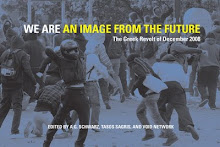
Leandros Kyriakopoulos participates in Void Network and he took part in the creation of the book "We Are an Image from the Future / The Greek Revolt of Dec. 2008", edited by A.G. Schwartz, Tasos Sagris & Void Network with the essay titled:
"December’s riots as mediated by the image of mass media"
for more info about Unfamiliar Magazine were this article first published:
The Unfamiliar- an Anthropological Journal







 Posts